
The first sod for the Chapel was turned on St Cuthbert’s Day in 1993 by Mr Harvey Alison, Trust Board Chair, and Marie Taylor née Lindberg, Past President of the Old Girls’ Association and Chair of the Chapel Appeal Committee. The Old Girls had decided, with the support of the Trust Board, to mark their Association’s 75th anniversary by building a chapel for the College. The Reverend Gaye Churchill was inducted as the first College Chaplain when the completed chapel was consecrated on 30th November 1993.
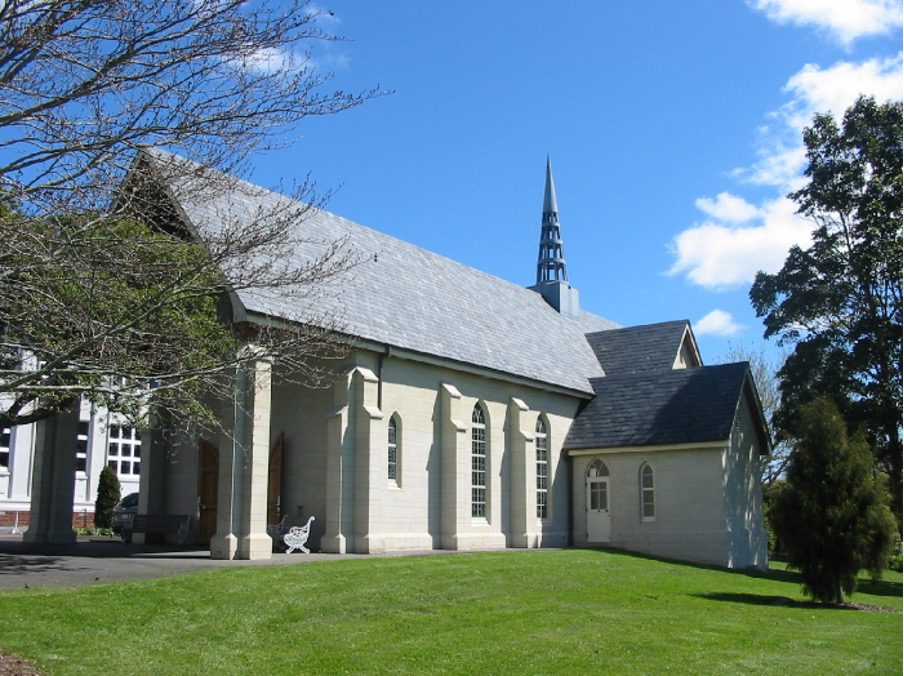
2. The Old Girls’ Chapel
‘The founders of St Cuthbert’s would be proud to see their aims to provide an all-round education, both spiritually and academic, for young women have been firmly instituted and that today the College is one of the leading girls’ schools within New Zealand. The addition of a Chapel fulfils the final part of this dream and will bring a spiritual dimension to the College, which can only strengthen the already firmly established Christian base. The opportunity to create a quiet tranquil space in the midst of our ever increasingly busy lives cannot be underestimated …. The values learnt by the girls during their formative years at school stay with them as they go through life. A Chapel will provide a tangible link for many with the College during the years ahead and further strengthen the family nature of our College. I cannot think of a more appropriate choice of gift for the Old Girls’ Association to mark their own 75th Jubilee.’ Frances Compton.
In early 1992, to mark the 75th anniversary of the Old Girls’ Association, the decision was made, with the support of the Trust Board, for the Association to build a chapel for the College. A site was selected at the front of the school on Market Road between the two main entrance gates. The design, by architect Sinclair and Associates, which followed ‘a traditional theme incorporating modern features and materials’, was thought to be distinctly ‘St Cuthbert’s’ in its architecture. Fundraising began in earnest in September of the same year with the launch of the Chapel Appeal with Mrs. Marie Taylor taking on the chairmanship of the fundraising committee. In order to start the external structure of the building the Old Girls’ Association needed to raise $350,000. The March 1993 College Ties was unsurprisingly full of news about the Chapel fund raising efforts. These included a fashion parade, which involved both the pupils and Old Girls as models, backstage helpers, as well as band and dance troupe members. This effort raised a tot al of $6,500 for the fund. Other fundraising pushes included a Mid-Winter Christmas Dinner, the sale of cards depicting the House window designs, which were to be installed in the Chapel, and a lunch hosted by the Chinese community. In addition there was a telephone campaign, which saw Old Girls choosing different graduating year groups and manning every available phone in the evenings at the College. It was a massive campaign by the Association, and not achieved, as one Old Girl has noted, ‘with only cake stalls’. It took the Association just six months to exceed its $350,000 target. However, this was just the beginning. The Chapel also required furnishing, and fundraising continued for such items as pews, silver, linen, robes and a cross. The Association president Margaret Flexman wrote of the campaign in College Ties: ‘It is a great pleasure to report on the success of the Chapel Fund-raising Appeal – our sincere gratitude to all who have contributed to achieve the target figure …. Many Old Girls have worked extremely hard to ensure the success of the Appeal but the rewards have been far greater than just financial achievement. The bonding experience of working towards a common goal, the making and renewing of friendships, the involvement of the whole College family are some of the numerous sentiments expressed.’ In May 1993 the foundations were laid for the Chapel and the project went forward at great pace. The structure was built of Hinuera stone with a slate roof, and the interior was finished using rimu. Due to the success of the first fundraising push the Association continued with the appeal in order to raise money for the 13 stained-glass windows which feature in the Chapel. Beverley Shore Bennett designed the windows with their Celtic and New Zealand motifs. Stephen Belanger-Taylor created the stained glass. The six lancet windows along the sides of the Chapel are in the College’s house colours, and the imagery acknowledges the history of the College and of the Presbyterian Church. A further two windows referencing the two new Houses are, at the time of writing, being commissioned. The two windows in the side room feature a Celtic design. There are two striking rose windows at either end of the Chapel, one with the St Cuthbert’s cross centred in a larger cross of Celtic design, and the other showing events in Saint Cuthbert’s life. The foyer windows depict images of angels holding aloft the words of the biblical foundation – faith, hope and love – on which the College is formed. The windows were dedicated in 2000. The building was completed by the end of the year, and the Reverend Gaye Churchill was inducted as Chaplain on 30 November 1993 when the Old Girls’ Chapel was consecrated. At the Service of Consecration attended by representatives of the Jewish, Pasifika, Māori and other Christian denominations, Rosemary Harris, President of the St Cuthbert’s Old Girls’ Association, unveiled the dedication stone, which reads: A GIFT FROM THE OLD GIRLS TO THE COLLEGE IN 1993 TO COMMEMORATE THEIR 75TH JUBILEE – BY LOVE SERVE.
St Cuthbert’s College 100 Years. Kelly Ana Morey p.189-191 2014

2.1 Saint Cuthbert Icon – gifted in 2002 by Old Girl Friends (7) of 1952.
This Greek style icon painting of Saint Cuthbert by Aidan Hart is a gift by Old Girl Friends (7) of 1952 – Cherie Black n. Baigent, Margaret George n. McArthur, Patricia Hookham n. White, Jennifer Robin Muirhead n. Don, Beverly Parkinson n. Pearce, Janet Sumpter n. Monteith, Margaret Young n. Miller. The group commissioned then Brother Aidan Hart, a New Zealander living at the time at the Hermitage of St Anthony and St Cuthbert Shrewsbury, Shropshire to paint an icon of Saint Cuthbert. It was presented to the Chaplain at St Cuthbert’s Old Girls’ Chapel Service in March 2002
“Aidan Hart was born in England in 1957 and grew up in New Zealand. There he worked as a full-time sculptor for a number of years after completing a degree in English literature and a Diploma in Secondary Education teaching. In 1983 he became a member of the Orthodox Church, returned to live in England, and began to work as a professional iconography. While continuing to work as an iconographer, from 1988 to 2000 he tested his vocation as a monk, including spending a total of two years on Mount Athos and six as a hermit in Shropshire, UK. This intense life of prayer had a profound effect on his work. He is now married with two children, his best icons yet”.

2.2 The St Cuthbert Banner gifted in 2003 by Gambrill Family to mark Elizabeth’s years at St Cuthbert’s
Gifted in 2003 by the Gambrill Family – Chris, Anne and daughter Elizabeth to mark Elizabeth’s years at college 1984-1996, it was designed by Beverley Shore Bennett in 1997 and made by Alison Nicholls. It features Cuthbert’s pectoral cross found when his grave was opened in 1827, reputed to have been made in the 5th Century, it is now housed in Durham Cathedral.
2.3 Stained Glass Windows including House Windows
The chapel features a collection of stained-glass windows made by Stephen Belanger-Taylor to the designs of Beverley Shore Bennett. The windows acknowledge the history of the college, the presbyterian church, and the life of Saint Cuthbert.
The two windows in the side room feature a Celtic design. There are two striking rose windows at either end of the Chapel, one with the St Cuthbert’s cross centred in a larger cross of Celtic design, and the other showing events in Saint Cuthbert’s life. The foyer windows depict images of angels holding aloft the words of the biblical foundation – faith, hope and love – on which the College is formed.
The six lancet windows along the sides of the Chapel are in the College’s house colours, and the imagery acknowledges the history of the College and of the Presbyterian Church.
By 1962 the college roll had grown, more houses were needed so Lindisfarne along with Iona and Kelso houses were established. During his lifetime Cuthbert was a monk, Bishop and hermit on the island of Lindisfarne also known as Holy Island.
A further two windows referencing the two new 2013 Houses were also commissioned.
Each House window is designed to tell a story, using images, symbolic colour and iconography in stained glass.

Above is Beverley Shore Bennett’s 1993 design for the Lindisfarne House Window.

The above image details the symbols that appear in it L-R top then bottom row:
1. Elder Ducks
2. Lindisfarne Gospels
3. Lindisfarne Island
4. Cuthbert – the shepherd boy
5. Celtic Cross
6. Lindisfarne Priory Door.
See also: